
TSUNAMI
Physics
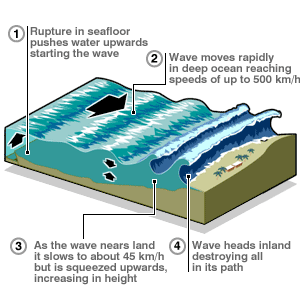
In deep water, the energy of a tsunami is constant, a function of its height and speed. Thus, as the wave approaches land, its height increases while its speed decreases. A tsunami has a very long wave length (in the order of 100 km), which makes it act as a shallow-water wave.
Since the speed of a shallow-water wave is
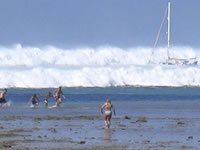
, where g is the gravitational acceleration and d is the water depth, a tsunami in the open ocean can obtain a speed of about 700 km/h. While in deep water a person at the surface of the water would probably not even notice, the wave can increase to a height of 30 m and more as it approaches the coastline. Tsunamis can cause severe destruction on coasts and islands. If it was caused by e.g. an earthquake, this may be the case at locations where the earthquake itself (with seismic waves travelling faster and therefore arriving earlier) was not even noticable without instruments.Considering the speed of the wave and the fact that thousands of kilometers from its origin a tsunami can cause damage, there may potentially be some hours of warning time.Typically, the sea recedes from the coast before it returns with the high wave. This is also a useful warning sign, important to know, otherwise people may stay at the shore out of curiosity.
HistoryThere are many ancient descriptions of sudden and catastrophic waves, particularly in and around the Mediterranean. Thousands of Portuguese who survived the great 1755 Lisbon earthquake were killed by a tsunami which followed a few moments later. Before the great wave hit the harbor waters retreated, revealing lost cargo and forgotten shipwrecks.The island volcanoe of Krakatoa in Indonesia, exploded with devastating fury in 1883. A series of large Tsunami waves were generated from the explosion, some reaching a height of over 40 meters above sea level. Tsunami waves were observed throughout the Indian Ocean, the Pacific Ocean, the American West Coast, South America, and even as far away as the English Channel.
Estimated death toll now stands at 150 000 - 2nd January 2005
26 Dec 2004 - Indian Ocean tsunami
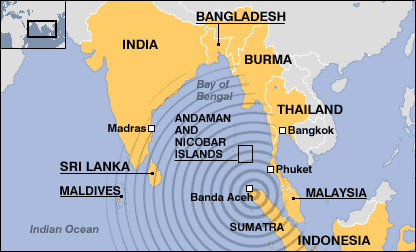
The magnitude 9.0 2004 Indian Ocean earthquake triggered a series of lethal tsunamis on December 26, 2004, with over one hundred and fifty thousand fatalities, ranging from those in the immediate vicinity of the quake in Indonesia, Thailand and the north-western coast of Malaysia to people thousands of kilometres away in Bangladesh, India, Sri Lanka, the Maldives, and even as far as Somalia in eastern Africa. The death toll from this event makes it the deadliest tsunami in recorded history.
Unlike the Pacific Ocean, there is no organised alert service covering the Indian Ocean. This is in part due to the absence of major tsunami events since 1883 (the Krakatoa eruption) and an emphasis on developing a tropical cyclone warning system. 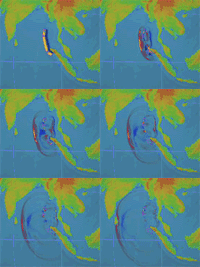
The tsunami has sparked the largest ever relief efforts, gathering $2 billion dollars in contributions so far.
Future threats
In 2001, scientists predicted that a future eruption of the Cumbre Vieja volcano in the Canary Islands could cause a 300-foot megatsunami to devastate the east coast of North America. However, other scientists dispute this and state that the threat is exaggerated.
Images:
Tsunami resources:
Aquabox & Shelter Box:
If you give your money to The Rotary Club it will go towards the purchase of these fantastic Shelter and Aqua Boxes.
Tsunami Relief Donations:
Telephone Donations (UK):
0870 60 60 900Trace lost relatives:





Kenga™ Web Design